



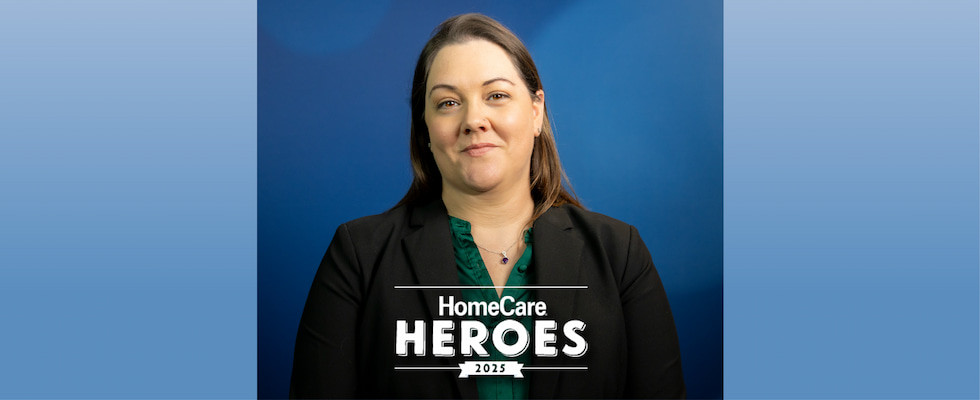


When Sam Williams started out her nursing career in critical and intensive care, she learned something about living—and about dying.
“You really bear witness in the ICU to really bad end-of-life care,” she said. “You see patients come in to die in a unit and it’s not a good experience.”
So, after going back to school and a foray into preventative medicine, Williams found her way into palliative care. Today, she’s the national director of palliative care operations for Compassus.
“Really from the interview process to the first day, I thought ‘This is it. This is what I’ve been looking for. This is full circle, this is how we can do it better,’” Williams said. “We’re giving patients that timeout moment and saying, ‘I want to know what’s really important to you, what you value at the end of your life; I want to align that with how you’re making health care decisions.’”
Part of that conversation, she said, includes educating patients about what palliative care involves, whether it comes at the end of life or at another stage in someone’s journey. To make this type of care more widely understood and available, Williams helped create a pilot program for Compassus that trains nurse practitioners how to use virtual visits (plus some in-home checks) to do a multi-point assessment on patients that includes evaluating their medication management, home safety and caregiver burdens. The goal is to allow nurses to see more patients—and educate them—without having to spend as much time on the road.
“It’s hard when you’re behind the windshield—that takes up a lot of time. Sometimes as a provider, it’s very frustrating because it feels like that’s time that I could be seeing my patients and doing care coordination, and instead I’m running up and down the interstate.”
At the same time, she said, many providers are overwhelmed by virtual visits. They jumped into providing care that way during the pandemic—eagerly adapting as so many homecare providers do—but that doesn’t mean they’re trained to do it systematically or well, she added.
“Sometimes it’s intimidating to really know where to start when you’re on a screen with a patient versus sitting on their sofa and petting their dog,” she said.
The virtual visits include room-to-room views via phone or tablet so the team can check for things like clutter, handholds, rugs and lighting, as well as whether home medical equipment is set up correctly. They also provide a pill container, work with the family to make sure the unpaid caregivers aren’t overwhelmed and share collateral materials like symptom trackers and safety booklets. And there are recorded training videos that patients can access at any time.
The program started in Alabama, Oklahoma and Texas and at press time was about to expand to four more states (after a delay due to the pause on telehealth waivers). She said they’ve gotten positive feedback from patients, who like that it’s low-effort on their part. The providers, on the other hand, have had to challenge some of their preconceived notions.
“I think we kind of assume that maybe certain populations wouldn’t be able to navigate the virtual visit technology, but they absolutely can,” Williams said.
Williams’ professional journey became a personal one this year, when her father was diagnosed with ALS and the family quickly got him palliative care. Even with her understanding and her family’s own health care background—her father is a retired physician and her mother a retired nurse—he was only able to be on hospice for about six weeks before his death. That shows how hard it is for most people to access end-of-life and palliative care, she said.
“It really just solidified to me how important it is that I do what I do, how important palliative care is—increasing access to palliative care,” Williams said.
We Wish To Thank Our Partners

.png)